Pet Urine Isn't a Carpet Stain: Treat the System
Severe pet urine can move beyond carpet fiber into backing, padding, and subfloor. Learn why real pet odor removal requires treating the entire flooring system.
One of the biggest mistakes in pet-urine treatment starts with the word stain.
A stain sounds like something sitting on the surface: find the spot, spray a product, scrub it, extract it, deodorize it, and move on. That approach may be appropriate for a small, fresh accident that has not penetrated deeply into the flooring system.
Severe or repeated pet urine is completely different.
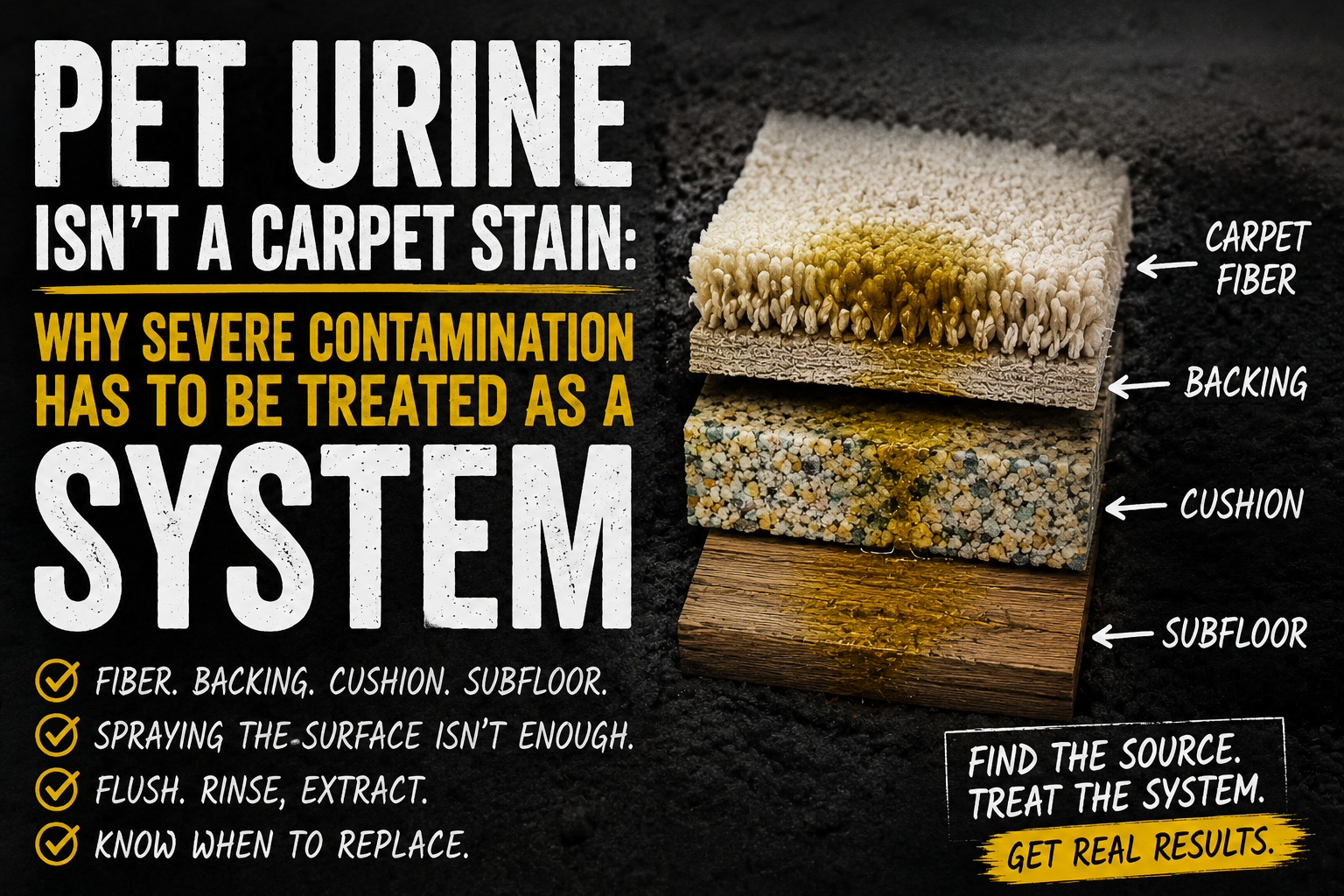
At Absolute Water Damage & Mitigation and Absolute Floors & More, we do not look at heavily contaminated carpet as a simple stain. We look at it as a flooring-system contamination problem. What homeowners see is carpet fiber. What may actually be affected is the carpet fiber, primary and secondary backing, cushion or padding, and potentially the subfloor underneath everything.
If you are treating only the surface, you may be treating the smallest part of the problem.
A carpet is more than what you walk on
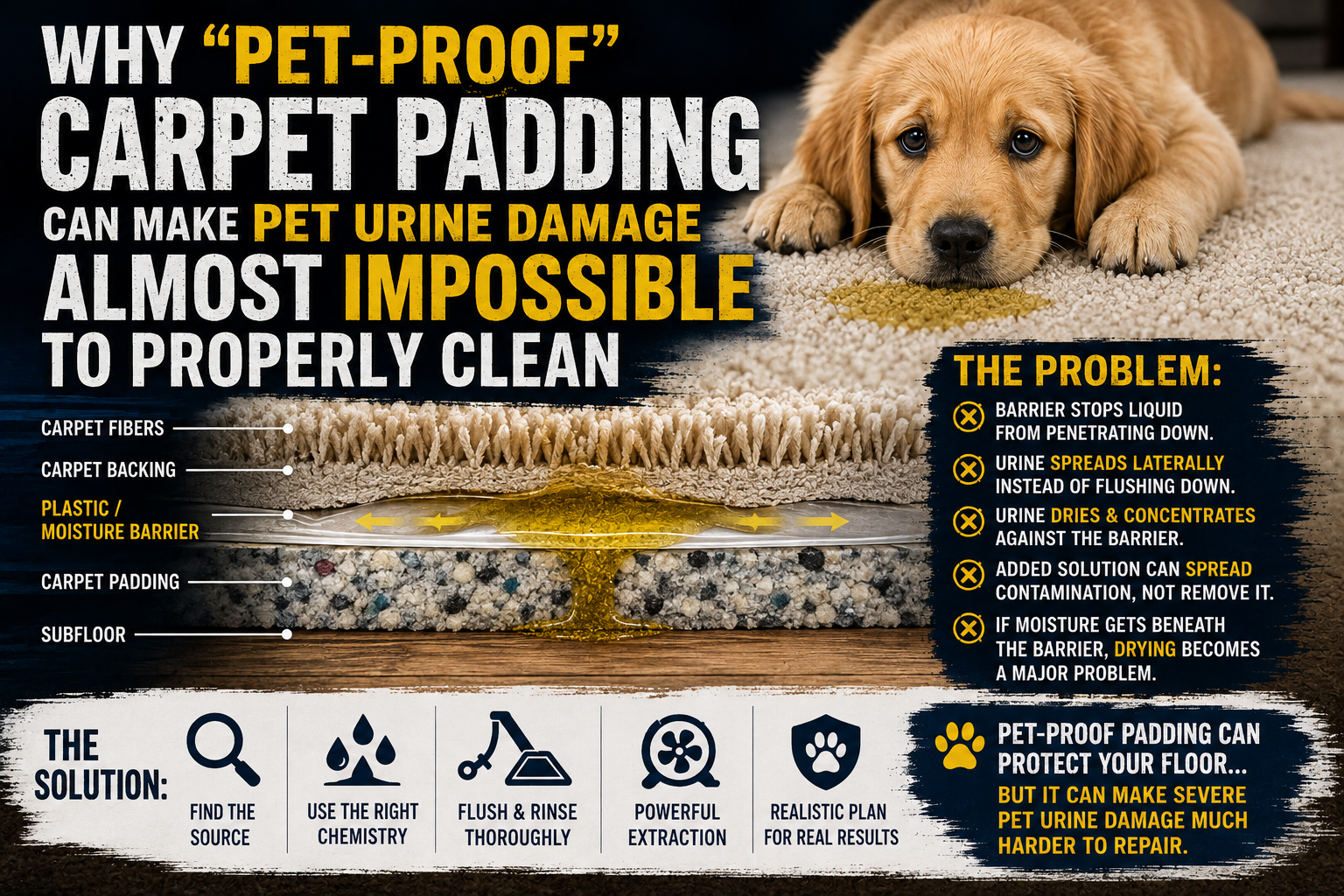
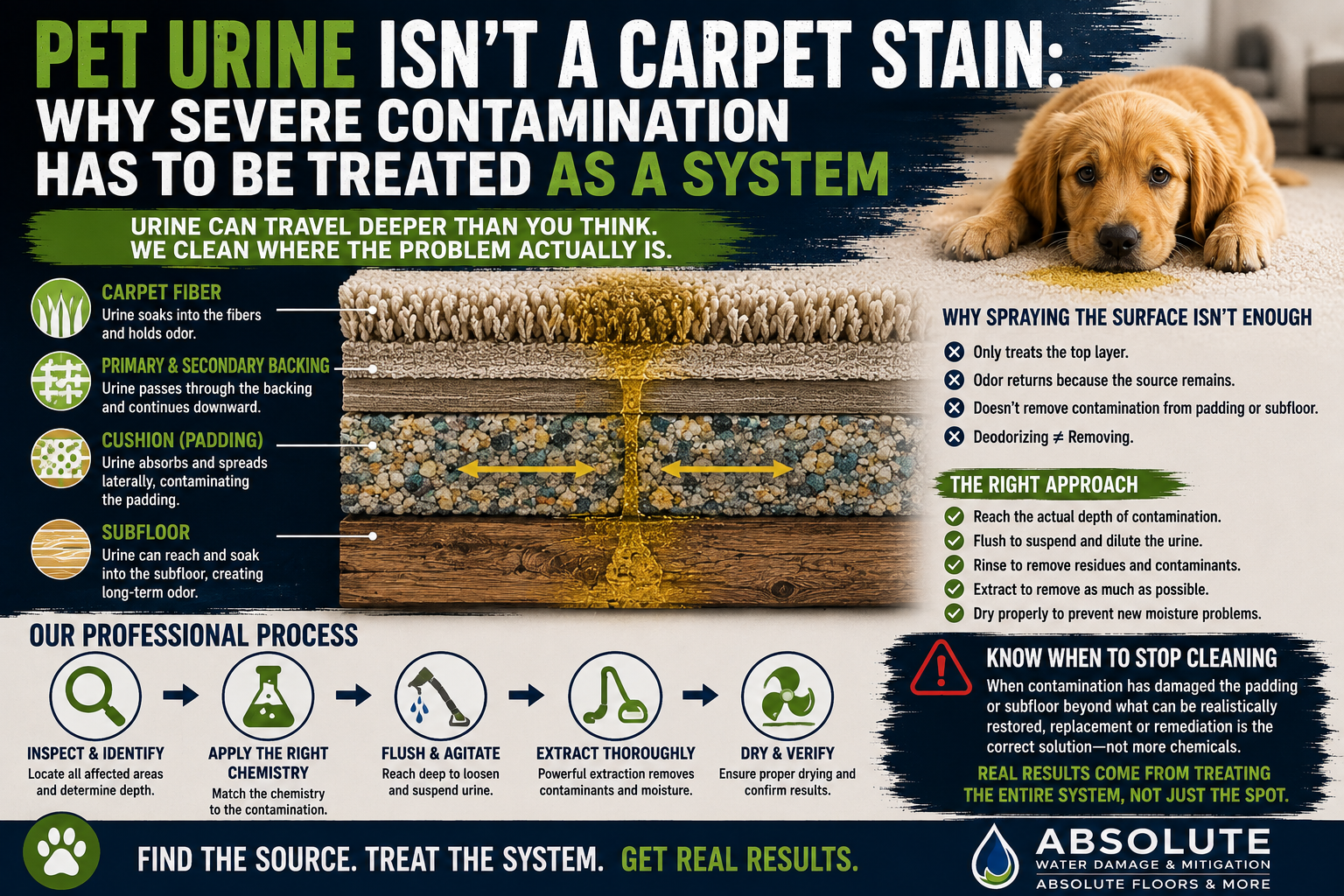
Most homeowners understandably think of carpet as one material. It is not. A typical installed carpet system contains several layers, and understanding those layers is critical when we are dealing with dog urine, cat urine, or recurring pet odor.
- Carpet fiber: the face yarn you see, touch, and vacuum.
- Primary and secondary backing: the structure that holds the carpet together and gives it stability.
- Cushion or padding: the layer beneath the carpet that can absorb and spread liquid.
- Subfloor: the wood, engineered wood, concrete, or other structural surface below the padding.
When a pet urinates on carpet, gravity does not care which layer we would prefer to clean. Liquid moves downward. Depending on the amount, frequency, carpet construction, and padding type, it can also spread laterally beneath the visible spot.
The spot you see is not necessarily the contamination you have
Imagine pouring water onto a towel sitting on top of a sponge. The wet area you see on the towel does not tell you exactly how much of the sponge underneath became wet.
Carpet behaves similarly. Urine enters the face yarn and can continue through the carpet backing. Once it reaches the cushion, the affected area can become larger than what is visible from above because liquid can move vertically and laterally through different materials.
Repeated pet accidents compound the problem. A dog or cat may return to the same general location over and over. What looks like several individual spots under ultraviolet inspection can represent a much larger contaminated area underneath the carpet.
That is why looking at the visible stain alone can be misleading.
Carpet fiber: the part everyone treats
Carpet fiber is the easiest part to access. It is also why so many pet treatments appear successful at first.
A deodorizer is applied. The carpet is agitated. The surface is extracted. Fragrance is added. The carpet looks better and the room smells better—until the odor comes back.
The problem is not necessarily that the product failed. The product may have treated exactly what it reached while the actual source remained deeper in the flooring system. If urine traveled beneath the face yarn, cleaning only the face yarn does not change what is sitting underneath it.
This is why application depth has to correspond with contamination depth.
Carpet backing: the layer people forget exists
Under the visible carpet fiber is the backing system. Urine does not have to stop when it reaches the bottom of the yarn. Liquid can move into and through the backing, particularly with repeated or significant contamination.
As urine dries, residues can remain in this area. Repeatedly spraying treatment onto the top of the carpet without determining whether the chemistry is reaching the backing can make the carpet smell better while leaving part of the odor source exactly where it was.
For professional pet urine removal, the question is not simply, “What product should we use?” It is, “Where is the contamination, and can the treatment safely reach it?”
Carpet padding: where a spot can become a much bigger problem
Once urine reaches conventional carpet cushion, the situation changes significantly. Padding is porous. Liquid can soak into it, spread, and accumulate with repeated accidents.
Now the technician is not simply trying to clean carpet fiber. We are trying to remove contamination from a material underneath the carpet that cannot be directly accessed from the surface in the same way.
This is where professional subsurface pet urine extraction can become important. The objective is to get appropriate treatment solution to the depth where contamination exists and recover that solution rather than merely leaving it behind.
You cannot extract what you never reached, and reaching contamination without removing it does not finish the job.
Subfloor: when carpet cleaning becomes restoration
Eventually, severe pet urine contamination can reach the subfloor. At that point, calling the entire problem a carpet stain becomes almost meaningless. The carpet might actually be the easiest material involved.
Urine contamination reaching wood, engineered wood products, concrete, or other structural flooring materials creates a different restoration problem. Porous materials can absorb contamination, residues can remain after liquid evaporates, and odor can persist even after the carpet and padding above appear clean.
This is why severe pet odor complaints sometimes continue after multiple professional carpet cleanings. Everyone keeps cleaning the carpet, while the source may no longer be primarily in the carpet.
Why spraying the surface is not enough
There are many pet-odor products available: enzymes, oxidizers, deodorizers, encapsulating products, fragrances, and urine pretreatments. Some can be extremely useful when they are matched to the correct situation.
But no bottle can answer the most important question: Where is the urine?
- If contamination is near the surface, a surface treatment may be appropriate.
- If it reached the backing, treatment needs to reach the backing.
- If it reached the cushion, the strategy needs to account for the cushion.
- If it reached the subfloor, spraying more product onto the carpet face will not clean the material underneath it.
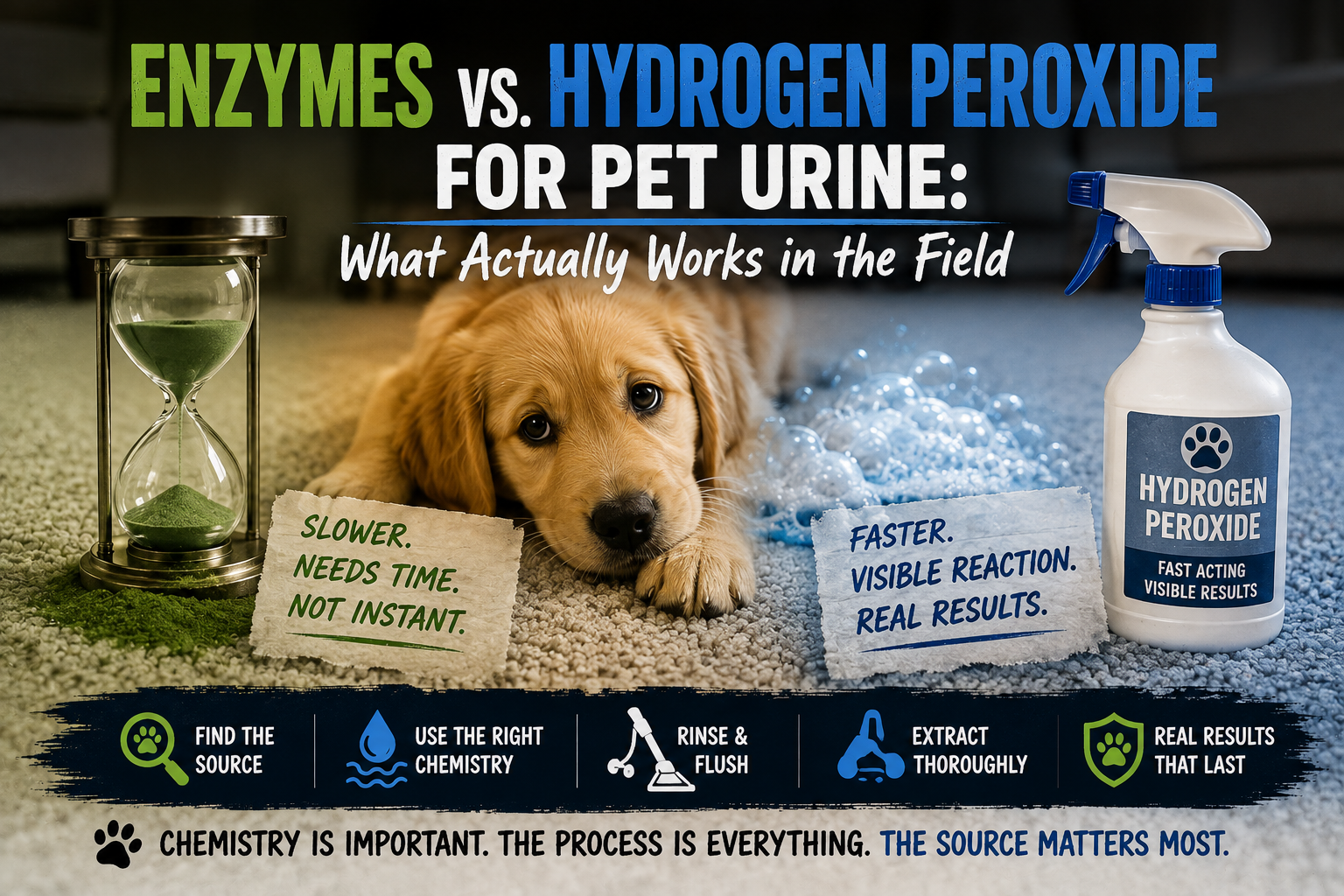
Enzyme pet urine treatment, hydrogen peroxide treatment, and oxidation-based chemistry can all have a role. The chemistry has to reach the source, and the process has to include a realistic way to remove what has been loosened.
Deodorizing and removing contamination are not the same thing
There is a major difference between changing an odor and removing its source.
A deodorizer can improve how an area smells. An oxidizer can chemically alter odor-producing compounds. An enzyme or biological treatment can help break down certain organic material. Those processes can all have a legitimate place in professional carpet cleaning.
But when significant physical contamination exists inside the flooring system, chemistry should be part of the removal process—not a substitute for it.
Our objective is not: spray, smell better, leave.
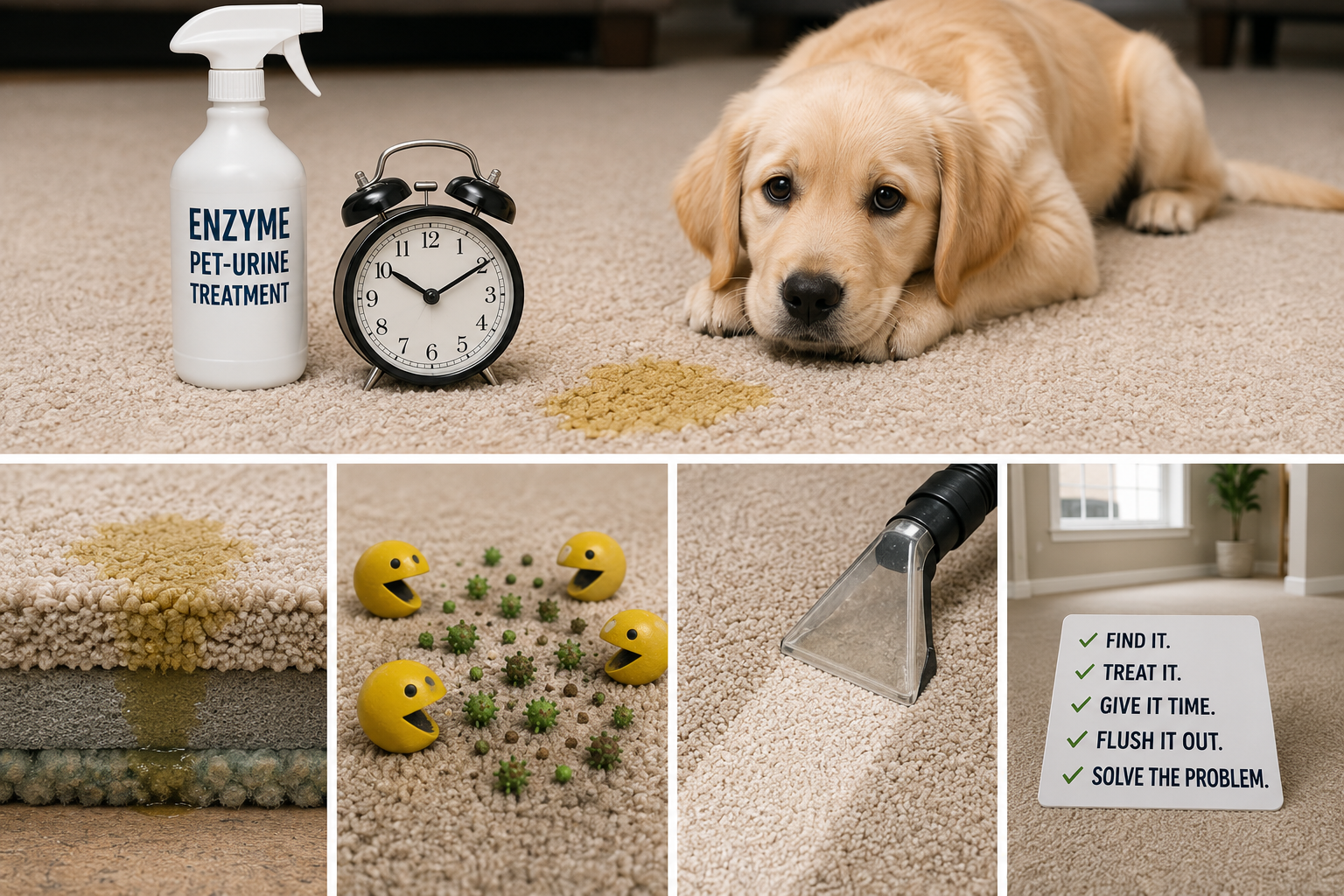
When conditions and materials allow, the objective is: locate, treat, flush, rinse, extract, dry, and verify.
Why flushing and extraction matter
Imagine washing a dirty plate. You would not apply dish soap, scrub until the food dissolved, and put the plate away covered in dirty soapy water. You rinse the contamination away.
Pet urine treatment follows the same principle. Chemistry helps loosen, dissolve, break down, oxidize, or suspend contamination. Then we want that contamination out of the carpet system.
With appropriate conventional carpet and padding, subsurface carpet flushing can allow us to introduce solution deep enough to interact with contamination and then recover that contaminated solution with specialized extraction equipment. Severe contamination may require repeated flushing and recovery until we have removed as much as reasonably possible.
The chemical helps us clean. The extraction helps us remove. Those are two different jobs.
The entire system determines the treatment
There is no universal pet-urine procedure. A responsible professional needs to understand what they are working on:
- What type of carpet is installed?
- What type of backing and padding are present?
- Is there a moisture barrier?
- What type of subfloor is below?
- How old is the contamination?
- How frequently did the pet use the area?
- How large is the affected area beneath what is visible?
- Can the materials safely tolerate the solution needed for treatment?
- Can the system be adequately extracted and dried afterward?
Those questions matter more than whether someone has a favorite pet-treatment chemical.
When pet urine carpet cannot be cleaned
Professional cleaners want to save carpet, and homeowners want that too. But there has to be a realistic limit.
If carpet and padding are extensively contaminated, repeatedly pouring chemistry into the system may become less responsible than removing affected materials. If the cushion cannot realistically be restored, replacement may be the right answer. If the subfloor is contaminated, exposing it can provide direct access for appropriate treatment. If moisture cannot be safely extracted and dried, we should not create an additional moisture problem while trying to solve an odor problem.
When the cost and uncertainty of repeated treatment begin approaching the cost of removing and replacing heavily contaminated materials, homeowners deserve to know that. Sometimes the most professional recommendation is to stop cleaning and address the actual source.
Replacement is not failure. Knowing what can be restored is expertise. Knowing what cannot reasonably be restored is expertise too.
Frequently asked questions about severe pet urine contamination
How deep does pet urine penetrate carpet?
A small, fresh accident may remain near the surface. Repeated or heavy contamination can move through carpet fiber and backing into padding and potentially the subfloor. The visible stain does not reliably show the full depth or spread.
Can pet urine be completely removed from carpet?
Many situations can be improved substantially with professional treatment, flushing, and extraction. Complete removal depends on the depth, age, amount, and materials involved. When contamination has reached inaccessible padding or subfloor, replacement or restoration may be the more realistic solution.
Why does carpet still smell like urine after cleaning?
The remaining source may be in the backing, padding, or subfloor rather than the carpet face. Surface cleaning can improve appearance and temporary odor without reaching deeper contamination.
Should carpet padding be replaced after pet urine?
Not every accident requires replacement. It may be appropriate when contamination is severe, repeated, inaccessible, or cannot be safely flushed, extracted, and dried. A professional evaluation can help determine the responsible option.
How do professionals remove pet urine from carpet?
The process begins with identifying the likely source and depth. Depending on the materials and condition, professionals may use appropriate chemistry, controlled flushing, rinsing, powerful extraction, drying, and—when necessary—padding replacement or subfloor treatment.
Professional pet urine removal in Colorado Springs
If you are dealing with old pet urine in carpet, dog urine odor that keeps coming back, cat urine under carpet, urine-soaked padding, or suspected subfloor contamination, Absolute Water Damage & Mitigation and Absolute Floors & More can help you understand the condition and your realistic options.
We provide professional pet urine removal, pet odor treatment, deep carpet cleaning, subsurface extraction, pet stain and odor removal, and restoration guidance in Colorado Springs. Our goal is not to cover up pet odor. It is to locate the contamination, treat the full flooring system when practical, remove as much as possible, and tell you honestly when replacement or more extensive restoration is the better path.
Call (719) 896-6274 to request a professional pet urine assessment in Colorado Springs.
Explore Topics
Written by
Nate Lemieux
Content creator and writer sharing insights and stories.