Enzymes vs. Peroxide for Pet Urine: What Works
Enzymes and peroxide treatments do different jobs. Learn why source detection, proper chemistry, flushing, and extraction matter for pet urine odor removal.
Pet urine treatment is not about finding the strongest-smelling bottle or the fastest promise on a label. It is about identifying where the contamination went, selecting chemistry that fits the carpet and the condition, and removing as much contamination as the carpet system allows.
For homeowners dealing with dog urine odor, cat urine odor, recurring stains, or a carpet that still smells after cleaning, the most common question is simple: are enzymes or hydrogen peroxide better for pet urine? The honest answer is that they do different jobs. Both can be useful. Neither is magic. And neither replaces a complete process of source detection, flushing, rinsing, extraction, and realistic expectations.
At Absolute Water Damage & Mitigation and Absolute Floors & More, we approach pet-urine treatment based on what is actually in front of us—not a one-size-fits-all chemical add-on.
The quick answer: chemistry matters, but the process matters more
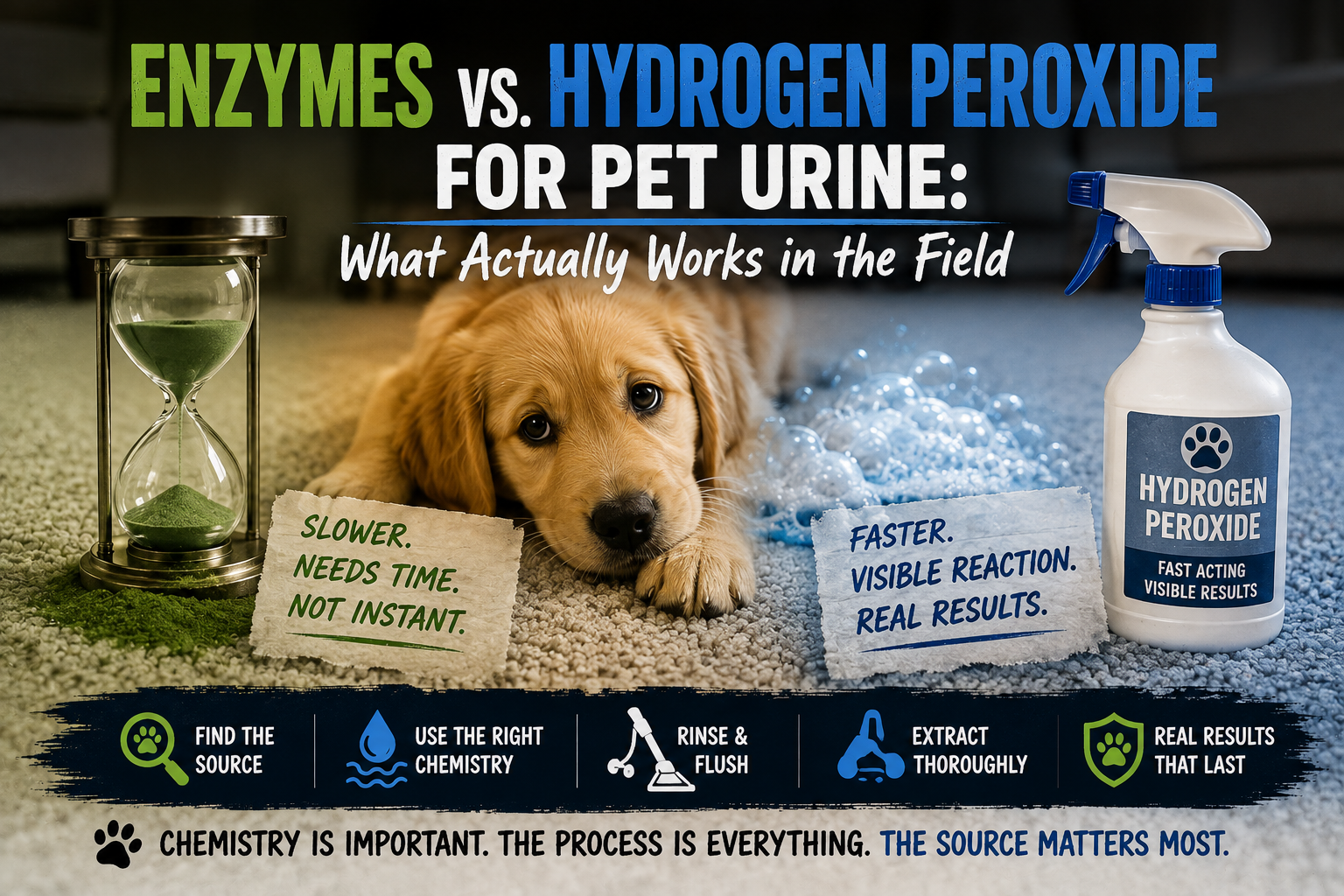
Enzyme products rely on biological activity and time. Properly selected hydrogen peroxide and oxygen-releasing treatments use oxidation to chemically change certain odor-producing molecules and residues. That difference can make oxygen-releasing chemistry especially useful in many real-world professional carpet-cleaning situations where homeowners expect visible progress during the appointment.
But a visible reaction is not the same as complete removal.
If urine has traveled through carpet fibers into the backing, padding, or subfloor, the treatment must reach the full depth of contamination. Once residues are loosened, dissolved, oxidized, or suspended, they still need to be flushed and extracted. Otherwise, the source may remain below the surface.
The goal is not to sell a bottle of chemistry. The goal is to solve the pet-urine problem as responsibly as the materials allow.
Enzymes and oxidizers are doing different jobs
How enzyme pet-urine treatments work
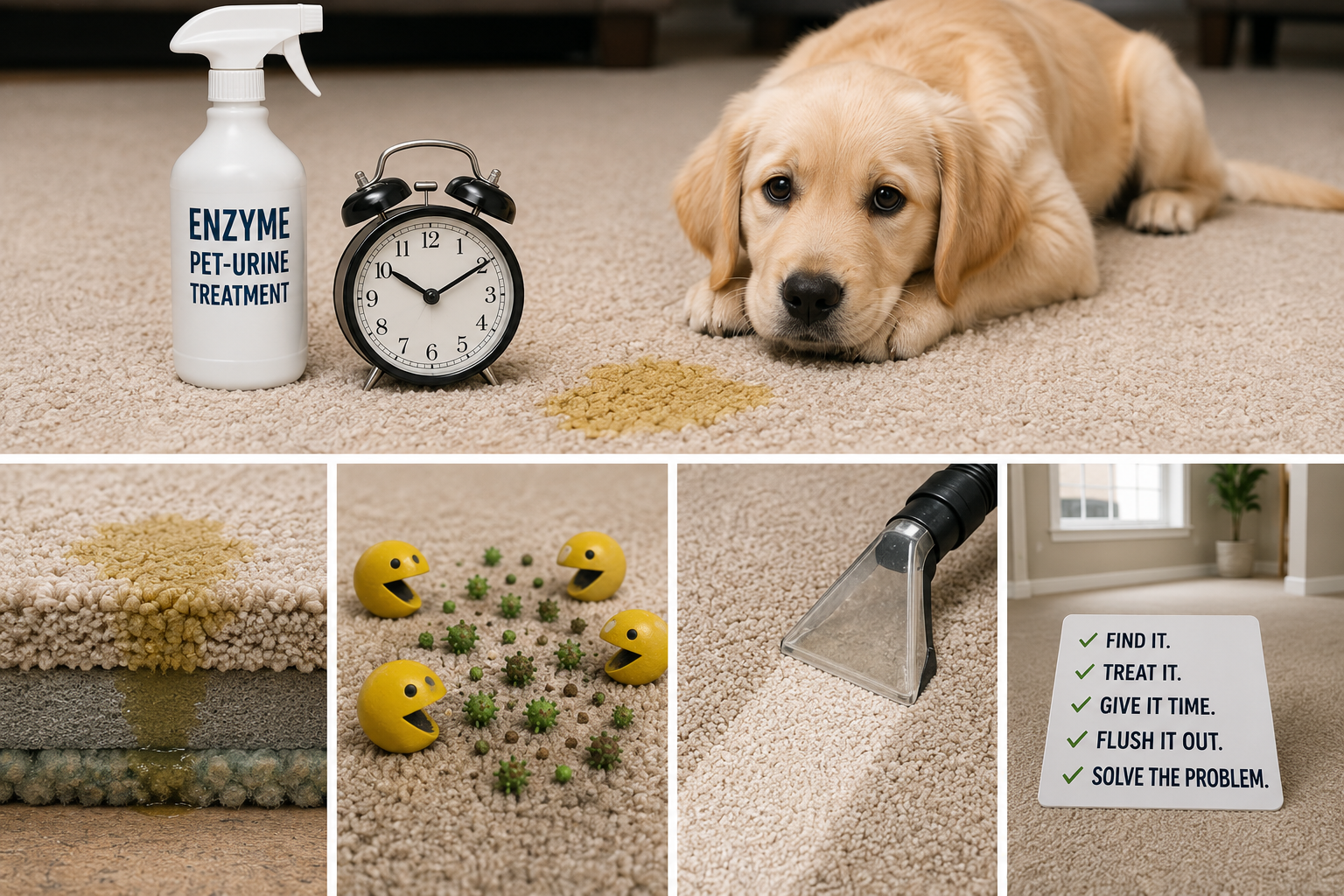
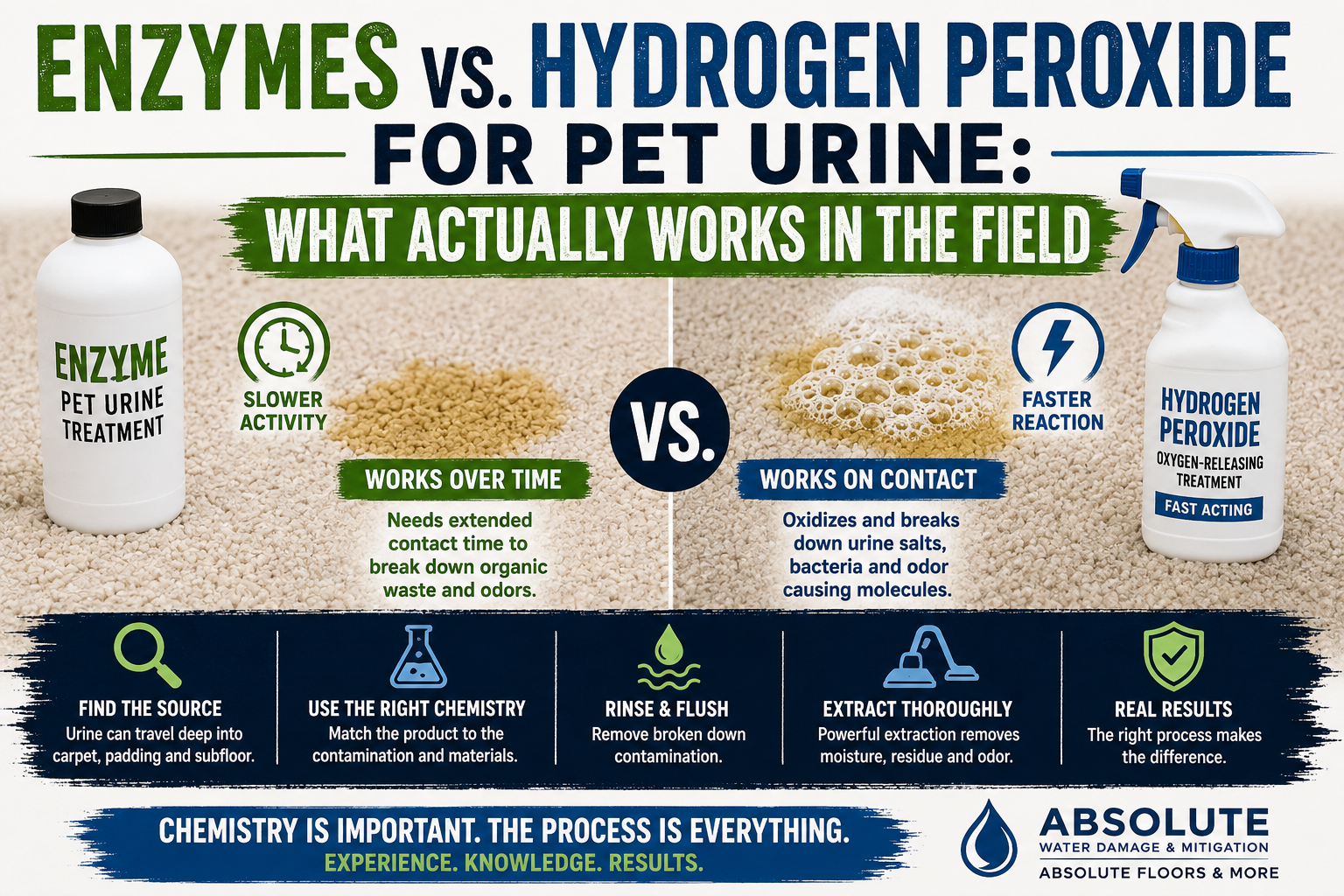
Enzyme and bacteria-based products are designed to interact with organic contamination. They can be helpful when they reach the affected material and have the time and conditions required to work. That last point is important: time is part of how many enzyme treatments work.
Some professional enzyme products call for extended dwell periods, sometimes allowing the treated area to dry naturally before extraction or evaluation. That does not mean enzymes are ineffective. It means a quick spray-and-extract appointment may not give an enzyme product the contact time it needs to perform as intended.
For a deeper explanation of dwell time, see our guide on enzyme pet-urine treatment and why odor can return.
How hydrogen peroxide and oxygen-releasing treatments work
Oxidation is different. Properly selected oxygen-releasing treatments can chemically change odor-producing molecules and help break down or mobilize certain residues. In the field, that reaction can be faster and more visible than biological activity.
When the correct professional product is mixed and applied under appropriate conditions, technicians may see solution movement, bubbling, or other signs of reaction. Temperature, agitation, solution movement, and the condition of the contamination can all affect what happens next.
That visible reaction is useful information. It is not proof that every bit of urine has been removed.
Why I often favor oxygen-releasing treatments in the field
A professional carpet-cleaning appointment is not a laboratory experiment. Homeowners call because they want the contamination addressed, the carpet cleaned, and a clear explanation of what can realistically be expected.
In many pet-treatment situations, a properly selected oxidation-based process can offer practical advantages:
- Faster chemical activity than a treatment that depends on long biological dwell time
- A more immediate opportunity to loosen and mobilize odor-producing residues
- A process that can be paired with flushing, rinsing, and powerful extraction during the service visit
- A clear way to evaluate the condition after the carpet dries
That does not make peroxide the automatic answer. The carpet fiber, dye stability, backing, moisture sensitivity, age of contamination, and depth of urine all matter. The correct chemistry is the chemistry that fits the actual job.
Visible reaction does not automatically mean urine is gone
This is one of the biggest misconceptions in pet odor treatment. Watching an oxygen-releasing treatment react can be impressive. Seeing contamination become suspended or appear to move toward the surface can be useful. But if contaminated solution remains in the carpet system, the job is not finished.
Think of the process in two parts:
- Chemistry helps change, loosen, dissolve, or mobilize contamination.
- Flushing, rinsing, and extraction help remove what the chemistry made available.
Skipping the second part is like washing dishes with soap and leaving the dirty water in the sink. The chemistry did something, but the contamination was not fully removed.
Professional pet odor treatment should be designed around both steps.
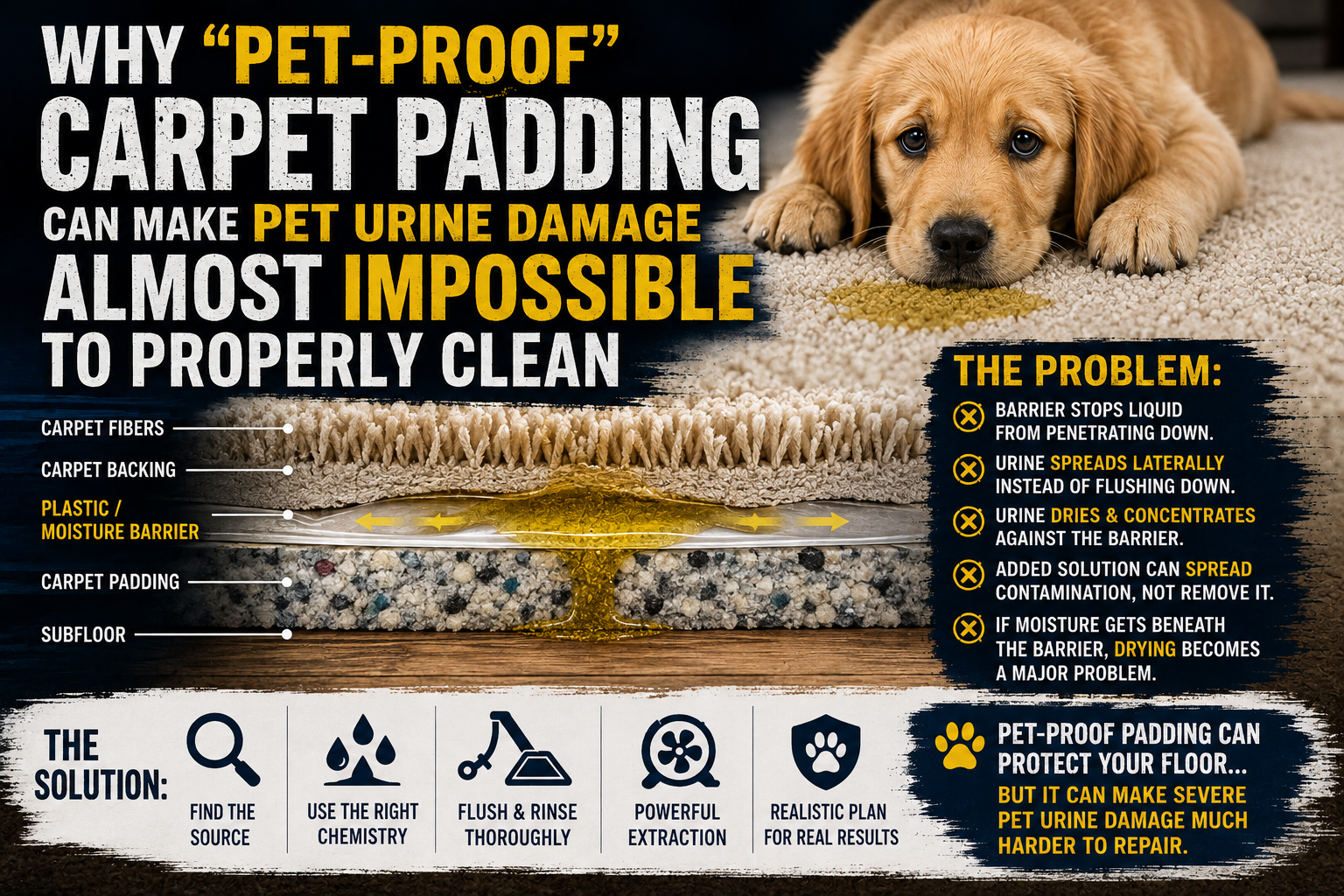
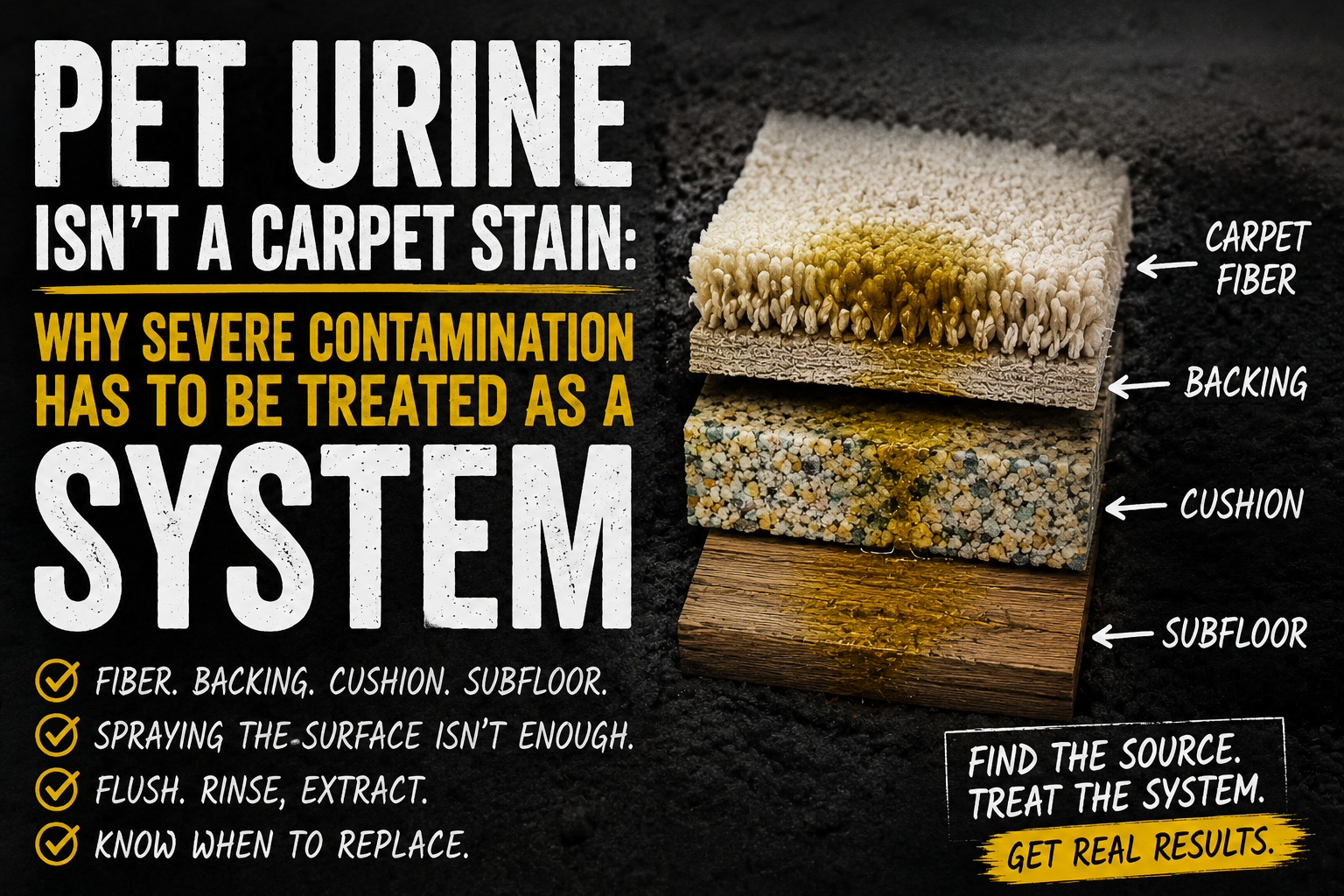
Pet urine does not always stay in the carpet face fiber
When homeowners see a urine spot, they see the top of the carpet. A professional has to think vertically:
- Carpet face fiber
- Carpet backing
- Carpet padding or cushion
- Seams, edges, and tack-strip areas
- Concrete, wood, or another subfloor material
One small, fresh accident may remain relatively close to the surface. Repeated dog or cat urine in the same location can be a completely different condition. Urine follows gravity, spreads through absorbent materials, and can travel farther than the visible stain suggests.
That is why simply spraying more deodorizer onto the carpet face may not solve a recurring odor. If the source is in the padding or against the subfloor, the treatment strategy has to account for that depth.
Severe pet damage changes the treatment strategy
There is a point where the problem is no longer a surface stain. It is a contaminated carpet system.
In those cases, professional judgment matters more than the name on a product label. A responsible plan may involve targeted subsurface treatment, controlled flushing and extraction, lifting or disengaging carpet for inspection, padding replacement, subfloor treatment, or—when the materials cannot be realistically restored—replacement.
More chemical is not automatically better. More water is not automatically better. A stronger product is not automatically the right product. If a subfloor or surrounding material is moisture-sensitive, the procedure must change to avoid creating a new problem while trying to solve the odor.
We would rather explain that limitation before work begins than repeatedly charge a homeowner for treatments that cannot reach or remove the source.
Hydrogen peroxide is not magic either
It is important not to replace one misconception with another. Hydrogen peroxide and other oxidizing products can be very effective when selected and used correctly. They also have limitations.
Improper use can affect carpet dyes, fibers, backing, or nearby textiles. Some materials require different chemistry, controlled application, thorough rinsing, or neutralization. That is why professional chemistry requires professional judgment—not just a stronger concentration or a longer dwell time.
The right question is not, “Which product is strongest?” It is, “What chemistry and process are appropriate for this carpet, this contamination, and this home?”
The professional process: find, treat, flush, extract, evaluate
A complete pet-urine treatment plan should follow a logical sequence.
1. Find the source
We begin by identifying likely contamination areas and asking about the history of the odor. Is it a new accident or a recurring issue? Does the odor return when humidity rises? Has the area been treated repeatedly? The answers help determine whether the problem may extend below the surface.
2. Select the right chemistry
The treatment should match the carpet, dyes, backing, contamination, and moisture conditions. Enzymes, oxidizers, and other professional products each have a place. No single product is right for every job.
3. Treat the full depth that can be safely reached
Surface-only treatment is not enough when contamination has traveled into backing or padding. The process must be designed around the likely depth of the source while protecting the materials involved.
4. Flush and rinse
Once residues are loosened or mobilized, flushing and rinsing help move them out of the carpet system. This is a critical step in reducing the remaining source.
5. Extract thoroughly
Powerful extraction removes moisture, suspended contamination, and cleaning residues. It also supports faster drying and gives us a more honest basis for evaluating the result.
6. Set realistic expectations after drying
A room should be evaluated after the carpet dries—not only while it is damp or filled with cleaning fragrance. If odor remains because contamination is deeper than cleaning can reach, we explain the next realistic option.
Frequently asked questions about enzymes vs. peroxide for pet urine
Is hydrogen peroxide better than enzyme cleaner for dog urine?
Neither is automatically better in every situation. Enzymes and oxidizers work differently. Properly selected oxygen-releasing treatments can provide faster activity in many professional applications, while enzyme products may require more time and contact. The right choice depends on the carpet, contamination depth, and treatment plan.
Can hydrogen peroxide remove pet urine odor from carpet?
It can be part of an effective professional process for certain situations. However, odor removal depends on reaching the source and removing as much contamination as possible. If urine is in the backing, padding, or subfloor, surface treatment alone may not be enough.
Why does pet urine odor return after carpet cleaning?
The remaining source may be below the carpet surface, the treatment may not have reached the full affected area, or humidity may reactivate dried residues. Repeated accidents can also create a larger contamination area than the visible stain suggests.
Can you guarantee complete pet odor removal?
An honest answer depends on the depth and extent of contamination. We can evaluate the condition, recommend an appropriate process, and explain what can realistically be cleaned. If affected materials cannot be fully restored, we will tell you before work begins.
Do I need to replace carpet after pet urine damage?
Not always. Many situations can be improved with professional treatment and extraction. But severe or repeated contamination may involve padding, subfloor, or damaged carpet materials. In those cases, targeted replacement or more extensive restoration may be the responsible recommendation.
Get an honest pet-urine evaluation in Colorado Springs
If you are searching for pet urine removal, dog urine odor removal, cat urine treatment, hydrogen peroxide carpet cleaning, enzyme carpet cleaners, or professional pet odor treatment in Colorado Springs, start with an honest evaluation.
Absolute Water Damage & Mitigation and Absolute Floors & More use real-world carpet-cleaning experience to identify the likely source, select appropriate chemistry, treat the full depth of contamination when practical, and remove as much of it as possible through proper flushing, rinsing, and extraction.
We do not promise instant miracles. We explain the condition, the process, and the realistic options for your home. Call (719) 896-6274 to request a straightforward pet-urine assessment.
Explore Topics
Written by
Nate Lemieux
Content creator and writer sharing insights and stories.